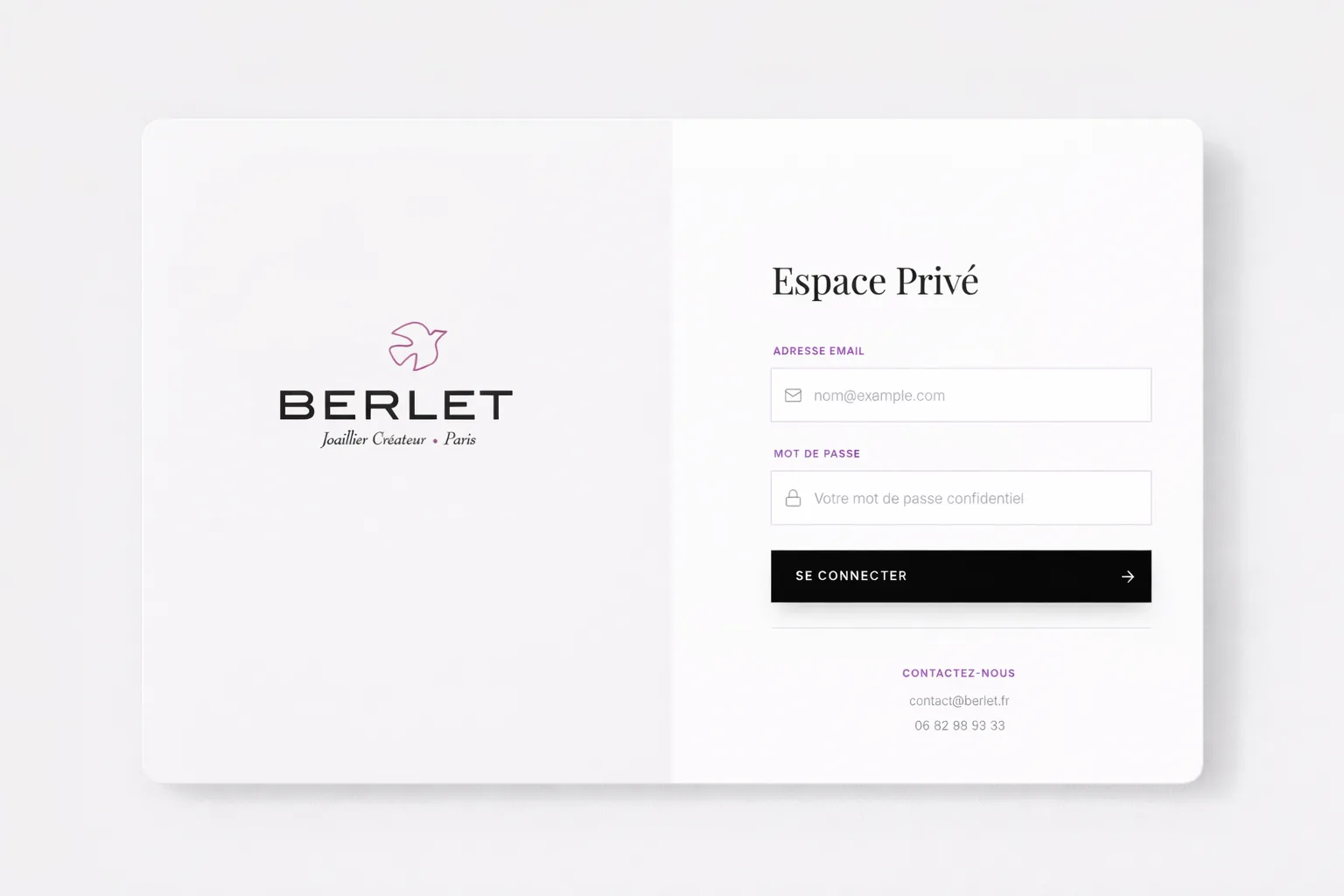
BERLET — Tailor-made merchant system & customer portal
We built a complete ecosystem: premium e-commerce journey, secure payments, inventory control, and a private client portal for each bespoke jewelry project.
React
Firebase
E-commerce
Customer portal
Context
BERLET needed more than a standard e-commerce website. The challenge was to sell premium pieces while preserving the workshop logic of bespoke production: strict validation cycles, precise client feedback, and high-touch support from first contact to final approval.
The main risk came from fragmented operations. Product data, design status, client feedback, support messages, and scheduling lived in separate channels, creating delays, context loss, and weak traceability on high-value orders.
Project objective: rebuild an end-to-end execution system that combines premium conversion on the storefront with structured collaboration in a private client environment.
Approach
We implemented the platform in two synchronized layers. First layer: the commerce architecture (catalog structure, product pages, checkout flow, secure card payment, order tracking, inventory consistency). Second layer: a React/Firebase private portal dedicated to bespoke collaboration.
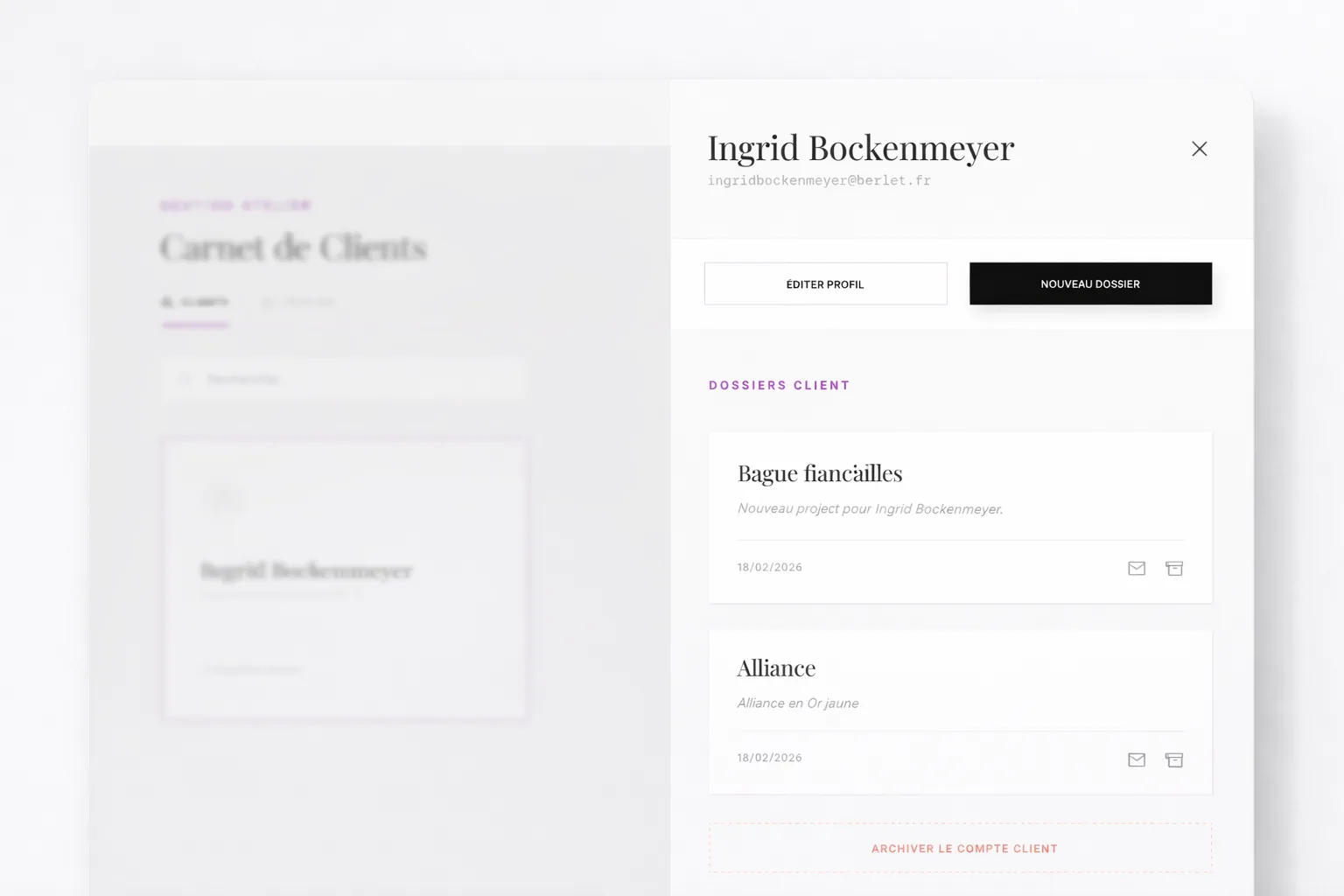
The portal handles design previews, contextual feedback, private messaging, and appointment booking. We also implemented controlled sharing logic so clients can share visuals externally without exposing sensitive business data such as pricing or internal workflow details.
This split improves execution clarity: the storefront drives acquisition and conversion, while the private portal drives production-grade collaboration.
Technical architecture
The commerce front-end was designed for conversion and operational readability: clear product hierarchy, friction-reduced checkout, and mobile-first continuity where premium buyers often initiate first interactions.
The React/Firebase portal relies on structured states, scoped permissions, and timestamped interactions. Every decision point remains traceable across the lifecycle (preview, feedback, revision, validation, final confirmation), reducing execution ambiguity.
We also defined governance rules for decision flow: who validates, when, and under which criteria. This turns the portal into an operational system, not just a communication layer.
Operational execution model
Beyond UI, we standardized production behavior: naming conventions, request prioritization, response standards, and quality checkpoints. This reduced unnecessary back-and-forth and shortened approval cycles.
The BERLET team now works with a unified case view: centralized decisions, context-linked conversations, clear stage visibility, and reusable history for support. This improves reliability and reinforces the premium experience.
Results
BERLET now operates a full-stack execution system: acquisition and conversion on the commerce side, then high-touch bespoke collaboration in the private portal. Interactions are centralized, decisions are traceable, and premium consistency is preserved end to end.
From a business perspective, the architecture improves three critical dimensions at once: conversion quality, operational speed, and customer experience control on bespoke high-value projects.
Credit card paymentSecure e-commerce journey
Unified stockOwn vision by product
Private portalModels, chat, sharing, appointments
Measured outcomes
Across the first production waves, BERLET improved execution speed on bespoke orders: fewer loops, faster decisions, and stronger continuity between e-commerce and the private client portal.
Validation cycleFewer unnecessary iterations through contextual mockup feedback and approval tracking.
Operational time6 to 10 hours/week recovered on client coordination and manual follow-ups.
File reliabilityFull traceability of decisions, versions, and statuses for each project.
Perceived qualityPremium consistency from checkout to custom-design follow-through.
Measurements tracked via e-commerce analytics, React/Firebase portal logs, and team reporting.
Constraints and decisions
The project had to combine two demanding layers: e-commerce conversion and premium co-creation for bespoke orders.
ConstraintProtect high-end customer perception while keeping strict operational control on custom files.
Architecture choiceSplit commerce and private-portal layers, connected by clear status governance.
Execution decisionCentralize messages, versions, and approvals to avoid out-of-context decisions.
Direct benefit: less ambiguity for teams and smoother client execution.
Continuous steering and decisions
Steering is based on a weekly execution review: workflow incidents, validation delays, support load, and client friction points.
Every trade-off is tied to a concrete outcome: faster production, safer premium experience, and protected margin on bespoke orders.
Outcome: a stable system that keeps improving without slowing delivery cadence.
CadenceShort weekly review focused on decisions and actions
PrioritizationBacklog sorted by business impact + client impact
QualityTargeted controls on high-sensitivity steps