SBR Bioprog — Website & automated member operations
We structured a complete architecture for the orthodontic association: website, registrations, training and congress operations, member tracking, and financial management in one unified system.
Showcase site
Airtable
Zapier
Accounting events
Context
SBR needed tighter control over members, registrations for training and conferences, and recurring communication with orthodontists. The requirement went beyond a website: the team needed a reliable operational architecture.
Before implementation, membership statuses, communication logs, and event data were split across disconnected tools. That fragmentation slowed execution and weakened financial visibility.
Project objective: centralize core data and industrialize workflows to move from reactive administration to structured operations.
Approach
We designed the system in two complementary layers. First layer: website for registrations, event access, and institutional information. Second layer: Airtable backbone built as the administrative operating system.
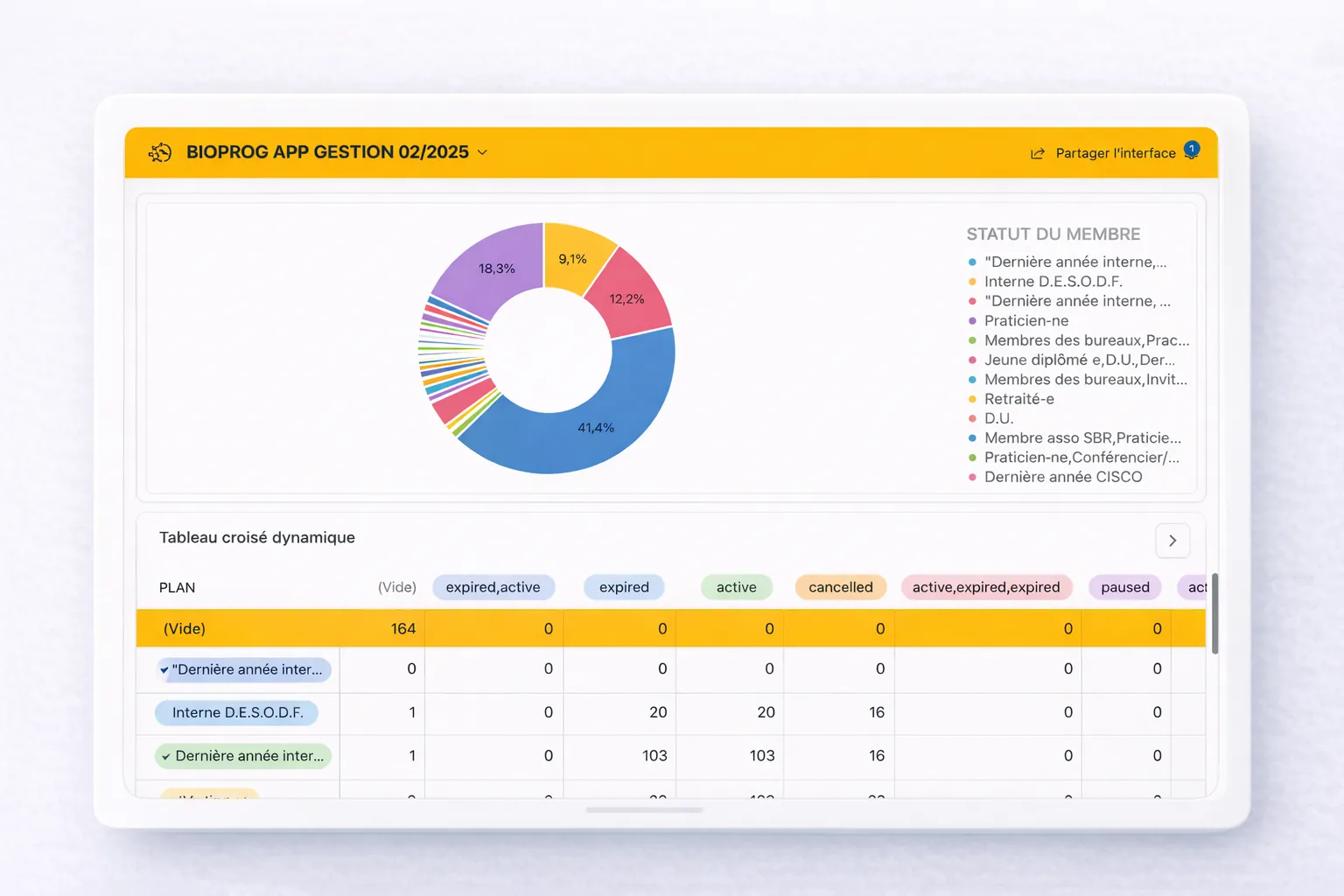
The Airtable model centralizes member directory, status lifecycle, interaction history, renewal reminders, SMS/email campaigns, supplier tracking, and profitability reporting per event.
We then automated the document flow with Zapier: post-training certificate generation, rule-based validation, and automatic participant delivery by email.
Technical architecture
The system uses a normalized data model across core entities: member, session, registration, payment, certificate. This structure reduces duplication, improves cross-team consistency, and makes historical analysis reliable.
Zapier automations are event-driven and mapped to explicit business states, which limits wrong sends and preserves full traceability of automated actions.
Execution model
Deployment followed a pragmatic sequence: data centralization first, communication flows second, and document automation third. This delivered immediate operational value without disrupting ongoing activity.
The team now works with a clear management cockpit to run memberships, events, and compliance tasks with stronger control and faster execution.
Results
The team now has end-to-end control of members, registrations, and training/conference finances. Reminders and required documents are automated, reducing administrative burden and improving execution speed.
The key gain is structural: higher data reliability, faster process execution, and better analytical leverage for financial and operational decisions.
Members directoryStatus, history, targeted communication
Congress managementSuppliers, costs, profitability, stats
Auto certificatesZapier generation + direct email delivery
Measured outcomes
Every deployment is tracked with business and operational KPIs. Depending on scope, metrics are consolidated at 30, 60, and 90 days to prioritize the next optimizations.
ConversionConversion rate, lead quality, and average order value
Time savedHours recovered from admin tasks and manual follow-ups
ReliabilityError rate, critical incidents, and avoided rework
ROIMargin protected, operating cost, and processing speed
Cross-checked sources: analytics, CRM, business database, and automation logs for dependable reporting.
Constraints and decisions
The scope combined institutional communication, member management, events, and certification document workflows.
ConstraintEvolving member database, renewal reminders, and event profitability tracking.
Architecture choiceShowcase website connected to a central Airtable base with email/SMS automations and certificate generation.
Execution decisionSecure member statuses and keep interaction history to improve governance reliability.
Result: clearer execution across membership growth, communication, and event economics.
Continuous steering and decisions
The project is run with a continuous-improvement logic: each change is linked to a concrete operational metric and a clear business objective.
Regular reviews allow fast trade-offs between UX quality, technical reliability, and team workload. This prevents expensive iterations that add little measurable value.
Outcome: more stable execution over time, better leadership visibility, and a system that keeps performing as volume grows.
CadenceRegular review of KPIs, incidents, and priorities
Trade-offsDecisions driven by measurable business impact
ReliabilityTargeted controls on high-risk steps
EvolutionActive backlog and executable roadmap
Goal: maintain premium execution standards without losing operational control.